
Highlights
- Economic Indicators Worsen as Short-Term Supply Shock Collides with Long-Term Structural Weakness
- China Tries to Divert Domestic Capital Toward Technology Ambitions
- China Continues Gray Zone Intimidation Against Taiwan with Unannounced Large-Scale Naval Deployments
- China Continues to Back Russia as Xi and Putin Pledge Deeper Cooperation
Economic Indicators Worsen as Short-Term Supply Shock Collides with Long-Term Structural Weakness
Weak industrial output data in April and lower manufacturing investment indicate the Iran conflict is adversely impacting China’s economy. If current trends continue, China could miss its 4.5–5 percent annual growth target, teeing up tough decisions in the Politburo meeting in July.[1]
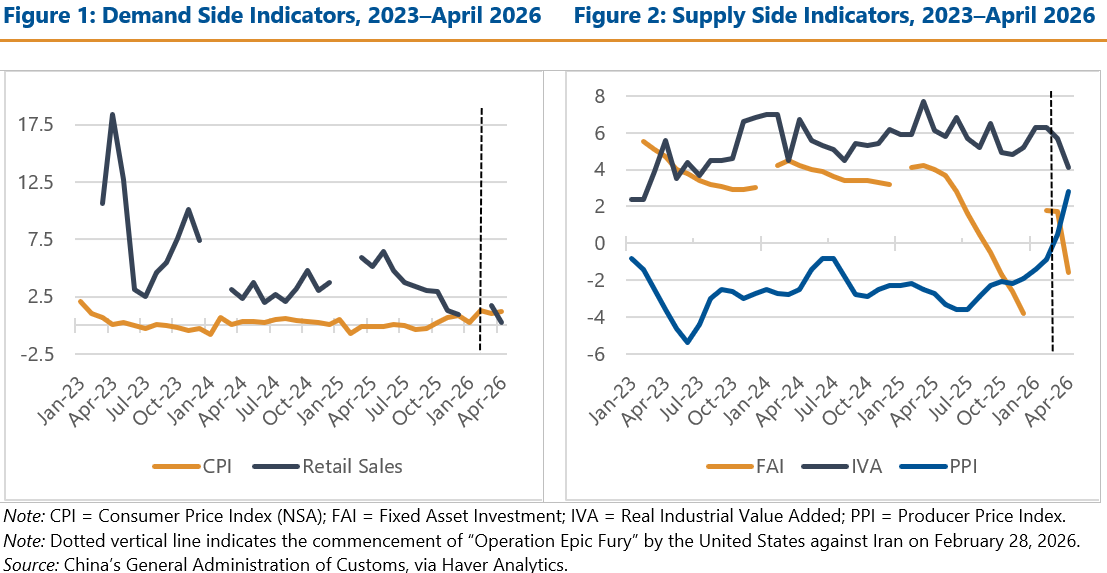
- Stagnant consumption and falling investment in China in April indicate a sharp reversal from the relatively resilient Q1 macroeconomic picture. On the consumption side, retail sales growth was 0.2 percent year-over-year, the lowest monthly figure since December 2022 at the tail end of Zero-COVID policies.[2] Concurrently, consumer prices increased after hovering near 0 percent for three consecutive years (see Figure 1). On the investment side, fixed asset investment (FAI) turned negative in April, with cumulative FAI declining 1.6 percent year-over-year (see Figure 2). Last year, FAI was negative for the first time in over three decades.[3] Slowing demand for credit from both households and businesses indicates further softening of both consumption and investment in the latter half of the year.[4]
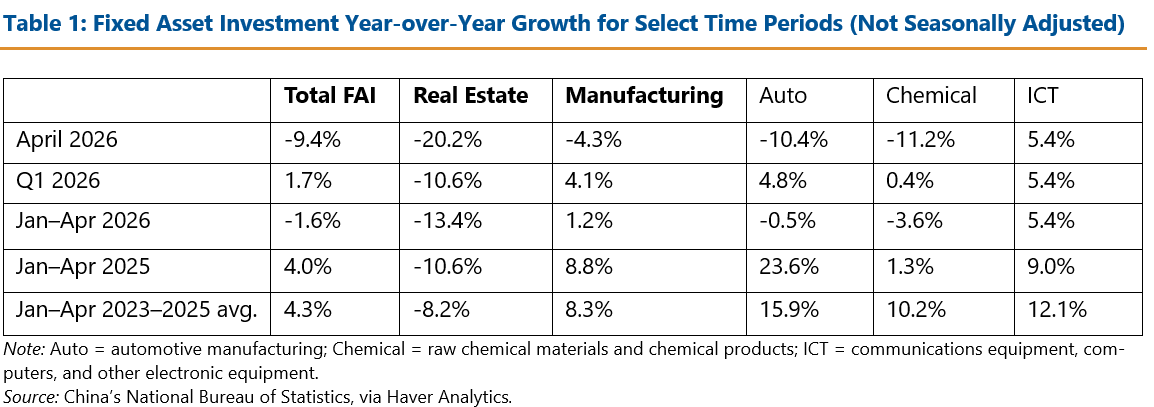
- Negative FAI in April comes despite significant policy signals China’s government would prioritize investment as a driver of growth this year. After FAI slid in 2025, the National Development and Reform Commission announced $42 billion for infrastructure projects to start 2026.[5] However, this has proven insufficient to offset decreased investment in the property sector, which continues to decline at an accelerating pace (see Table 1).[6] Moreover, local governments are using bonds traditionally earmarked for infrastructure to clean-up hidden debt and to buy back land from property developers, propping up the ailing real estate sector.[7]
- Industrial indicators provide early signs of the Iran conflict’s impact on China. The producer price index year-over-year growth shot up from -0.9 percent in February to 2.8 percent in April, reflecting rapidly rising import costs that may erode profitability of Chinese firms (see Figure 2).[8] At the same time as input costs are rising, output indicators are slowing: In April, real industrial value added sank to 4.1 percent, its lowest level since June 2023.[9]
- At the Chinese Communist Party (CCP) Politburo meeting in July, leaders will be confronted with uncertainty about whether exports can offset growing weakness in investment and consumption. Exports through April were up 14 percent over the same four months of 2025.[10] But pressure is mounting on the current export-oriented growth model. Manufacturing capacity utilization fell to 73.9 percent, nearing a decade low (excluding early 2020 shutdowns).[11] However, given General Secretary of the CCP Xi Jinping’s commitment to dominate high-value manufacturing, comprehensive consumption-focused fiscal stimulus remains unlikely.
China Tries to Divert Domestic Capital Toward Technology Ambitions
Two recent actions by Chinese regulators and the State Council further China’s ambition to ensure its private capital markets supplement its industrial policy.
- China envisions a domestic capital markets ecosystem in which household savings are used to bolster CCP industrial policy. China’s previous attempts to foster such a system have stalled. Some households have sought better returns abroad in contravention of China’s capital controls.[12] At the same time, China’s private capital-constrained environment has resulted in some technology companies listing or re-incorporating overseas to access global capital.* [13] Beijing recently sought to address each of these challenges to its vision.
First, China is cracking down on illicit channels for households to invest money overseas to force savings back into domestic markets.
- On May 22, the China Securities Regulatory Commission (CSRC) along with eight other agencies ordered the China-based operations of three digital securities trading platforms to cease operating in the Mainland.[14] The companies—Futu Securities, Tiger Brokers, and Longbridge Securities—had offered a channel for Chinese retail investors to move savings outside of China and evade capital controls by purchasing overseas equities.[15] Households must now access foreign securities only through two sanctioned and highly controlled channels: the Hong Kong-linked Stock Connect program and brokers and fund managers participating in the Qualified Domestic Institutional Investor (QDII) program.[16]
- By forcing retail investors to use controlled investment channels, China can better direct household savings to fund domestic equities.[17] Investors may switch to using the Stock Connect to invest in Hong Kong, where Chinese tech firm initial public offerings (IPOs) led the exchange to the number one global listing-venue by value in 2025.[18] The QDII program, through which Chinese households gain exposure to offshore financial markets, is subject to a quota, leaving households to inject leftover savings into domestic markets.[19]
Second, China issued new regulations establishing strict oversight of outbound investment to prevent the outflow of Chinese technology to overseas jurisdictions.
- On June 1, China’s State Council released the State Council Regulations on Overseas Investment (Decree No. 837), preventing investors from exporting restricted technology, knowhow, data, or other goods and services under the guise of outbound investment.[20] Individuals and entities violating the restrictions are subject to harsh punishments, including fines, visa restrictions, and industry blacklisting.[21]
- The regulations broaden Beijing’s authority against such moves after it forced the founders of artificial intelligence (AI) firm Manus to unwind their sale to Meta even though the firm had already relocated its headquarters from China to Singapore.* [22] (For more on Meta’s acquisition of Manus and efforts by other Chinese tech companies to relocate abroad, see the Commission’s China Bulletin from May 5, 2026.) The regulations come into effect on July 1, signaling the urgency of the issue to China’s leadership.[23]
Taken together, the new rules are a further step toward ensuring promising tech startups list on domestic exchanges or in Hong Kong and keeping Chinese household savings captive to ensure they are used to fund China’s technological ambitions.
China Continues Gray Zone Intimidation Against Taiwan with Unannounced Large-Scale Naval Deployments
Beijing’s latest large military activities in the Taiwan Strait seek to intimidate neighbors while avoiding heightened international scrutiny following the Trump-Xi summit.
- In late May, China deployed over 100 People’s Liberation Army (PLA) Navy and China Coast Guard ships across the first island chain.[24] The unusually strong presence included joint combat readiness patrols around Taiwan, aircraft carrier operations in the Western Pacific that likely focused on counter-intervention training, and other activities.[25] China did not frame the large-scale deployments as a single coordinated exercise or actively publicize its activities—unlike its previous Taiwan exercises, which have featured aggressive propaganda.[26]
- China often uses politically significant occasions in Taiwan as pretext to conduct military exercises aimed at intimidating the island.[27] The increase in military activity coincided with the second anniversary of Taiwan President Lai Ching-te’s inauguration and the 30th anniversary of Taiwan’s transition to democracy.
- Beijing has an interest in softening U.S. perceptions of the threat it poses to Taiwan following the Trump-Xi summit, as Xi presses U.S. President Donald Trump to curb U.S. arms sales to Taiwan.[28] While the large-scale deployment is part of a pattern of gray zone activities to intimidate Taiwan and neighboring U.S. allies Japan and the Philippines, China’s relative quiet is likely an effort to avoid unwanted attention from the United States that could galvanize U.S. support for Taiwan.
China Continues to Back Russia as Xi and Putin Pledge Deeper Cooperation
A May 19–20 summit between Xi and Putin showcased Beijing and Moscow’s ambitions for deeper strategic cooperation to compete with the United States and its allies, while underscoring the extent to which the relationship now runs on China’s terms.
The summit provided insight into areas where Beijing and Moscow seek deeper strategic integration. New commitments related to AI, satellite navigation, and long-term economic planning suggest both governments view advanced technology, economic resilience, and reduced dependence on the West as priorities for cooperation.[29]
The initiatives affirmed a 2026–2030 roadmap to link China’s BeiDou and Russia’s GLONASS satellite navigation systems, signaling top-level political endorsement of an agreement highlighted in the Commission’s 2025 Annual Report to Congress.[30] This suggests Beijing and Moscow are moving beyond rhetoric toward deeper technical integration in space infrastructure.[31]
The summit was likely designed to send a message that Beijing and Moscow remain strategically aligned in their efforts to reshape the international order in favor of their Axis of Autocracy.[32] Their joint statement criticized U.S. missile defense initiatives, sanctions, and aspects of the existing international order.[33] Even as Beijing seeks a more stable relationship with Washington, the summit signaled alignment between Russia and China in opposition to elements of U.S. foreign and security policy.[34]
The outcomes of the summit underscored that the China-Russia partnership increasingly runs on Beijing’s terms, however.[35] Despite extensive declarations of cooperation, the two sides again failed to finalize the long-discussed Power of Siberia 2 pipeline, a top Russian priority, agreeing only on unspecified “main parameters” with no details on construction timeline or pricing.[36]
The continued delay illustrates Beijing’s leverage over a partner that has grown structurally dependent on it.[37] Russia now relies on China for the bulk of its microelectronics and machine-tools, underscoring Beijing’s importance to Moscow’s defense-industrial capacity and war effort.[38] Beijing reaffirmed deep alignment with Russia while declining to deliver the terms Moscow most wanted, a posture that suggests it sees more value in a sustained partnership than in resolving Russia’s near-term priorities.
This issue of the China Bulletin was prepared by Graham Ayres, Rachael Burton, Zoe Merewether, and Matthew Sperzel. You may reach us at contact@uscc.gov.
Disclaimer: This bulletin is the product of research performed by professional staff of the U.S.-China Economic and Security Review Commission (USCC) and was prepared to support the ongoing research and deliberations of the Commission. Posting of this bulletin to the Commission’s website is intended to promote greater awareness and understanding of developing issues for congressional staff and the public in support of the Commission’s efforts to “monitor, investigate, and report” on U.S.-China economic relations and their implications for U.S. national security, as mandated by Public Law 106-398 (as subsequently modified in law, see uscc.gov/charter). The public release of this document does not imply an endorsement by the Commission, any individual Commissioner, or the Commission’s other professional staff, of the views or considerations raised in this staff-prepared bulletin.
Footnotes
- * Recently, some Chinese tech firms have relocated their headquarters outside of China and sought foreign buyers to be more attractive to customers in wider markets and reduce geopolitical exposure. Xinghui Kok and Claire Fu, “As Global Scrutiny Grows, Chinese Firms Look to Call Singapore Home,” Reuters, December 18, 2025. https://www.reuters.com/world/china/global-scrutiny-grows-chinese-firms-look-call-singapore-home-2025-12-19/; James Kynge, Jude Webber and Christine Murray, “‘Singapore Washing’: China’s New Back Doors into Western Markets,” Financial Review, September 9, 2024. https://www.afr.com/world/asia/singapore-washing-china-s-new-back-doors-into-western-markets-20240909-p5k8yj.
- * The State Council adopted the new regulations on outbound investment internally on April 17 before announcing its decision to block Meta’s acquisition of Manus but did not make the text public until June 1. China’s State Council, 国务院关于对外投资的规定 [State Council Regulations on Overseas Investment], June 1, 2026. https://web.archive.org/web/20260602103116/https://www.gov.cn/zhengce/content/202606/content_7070755.htm.
Endnotes
[1] “China’s Economy Succumbs to Slowdown and Reignites Stimulus Talk,” Bloomberg, May 17, 2026. https://www.bloomberg.com/news/articles/2026-05-18/china-economy-slows-sharply-as-investment-returns-to-contraction.
[2] China’s National Bureau of Statistics, via Haver Analytics; Olwen Wilson and Antoine Flahault, “China’s U-Turn on Its Covid-19 Policy,” National Institutes of Health, January 13, 2023. https://pmc.ncbi.nlm.nih.gov/articles/PMC9837380/.
[3] Daisuke Wakabayashi and Amy Chien, “Historic Shift Underway in China’s Economy as Investment Slump Deepens,” New York Times, December 12, 2025. https://www.nytimes.com/2025/12/12/business/china-investment-economy.html.
[4] Logan Wright, “Shades of 2022,” Rhodium Group, June 3, 2026.
[5] “China Rolls Out Early-Batch Major Projects to Accelerate Investment,” Xinhua, December 31, 2025. https://web.archive.org/web/20260603183113/https://english.news.cn/20251231/8079616947784fd69a6f782b41036896/c.html.
[6] China’s National Bureau of Statistics, via Haver Analytics.
[7] “Infrastructure SPB Issuance Slows Further in May,” Trivium China, June 2, 2026. https://triviumchina.com/2026/06/02/infrastructure-spb-issuance-slows-further/; “Housing Inventory Acquisition Special-Purpose Bonds Support China LGFVs' Policy Roles,” Fitch Ratings, June 29, 2025. https://www.fitchratings.com/research/international-public-finance/housing-inventory-acquisition-special-purpose-bonds-support-china-lgfvs-policy-roles-29-06-2025.
[8] China’s National Bureau of Statistics, via Haver Analytics.
[9] China’s General Administration of Customs, via Haver Analytics.
[10] China’s National Bureau of Statistics, via Haver Analytics.
[11] China’s National Bureau of Statistics, via Haver Analytics.
[12] “Why China Is Tightening Controls on Overseas Stock Trading,” Bloomberg, May 25, 2026. https://www.bloomberg.com/news/articles/2026-05-26/why-china-is-tightening-controls-on-overseas-stock-trading.
[13] Ma Jing, “去新加坡上市的中国企业越来越多了! 或成常态化补充策略?” [More Chinese Companies Are Listing in Singapore! Is This Becoming a Regular Supplementary Strategy?], Science and Technology Times, January 28, 2026. https://stcn.com/article/detail/3616477.html; Yu Shenliang, “国内企业开辟海外上市VIE之外新路径” [Domestic Companies Explore New Overseas Listing Path Beyond VIE], Science and Technology Times, April 14, 2023. https://www.stcn.com/article/detail/841851.html.
[14] China Securities Regulatory Commission, 中国证监会有关部门负责人就《综合整治非法跨境证券期货基金经营活动实施方案》答记者问 [China Securities Regulatory Commission Spokesperson Answers Questions Regarding the “Implementation Plan for Comprehensive Rectification of Illegal Cross-Border Securities, Futures and Fund Operations”], May 22, 2026. https://web.archive.org/web/20260528073119/https://www.csrc.gov.cn/csrc/c100028/c7634328/content.shtml; China Securities Regulatory Commission, 中国证监会等八部门联合印发《综合整治非法跨境证券期货基金经营活动实施方案》[China Securities Regulatory Commission and Eight Other Departments Jointly Issue the “Implementation Plan for Comprehensive Rectification of Illegal Cross-Border Securities, Futures and Fund Operations”], May 22, 2026. https://web.archive.org/web/20260522140543/https://www.csrc.gov.cn/csrc/c100028/c7634324/content.shtml; China Securities Regulatory Commission, 证监会严肃查处老虎等机构非法跨境展业案件 [China Securities Regulatory Commission Strictly Punishes Illegal Cross-Border Business Activities of Tiger Brokers and Other Institutions], May 22, 2026. https://web.archive.org/web/20260522140721/https://www.csrc.gov.cn/csrc/c100028/c7634330/content.shtml.
[15] William Sandlund and Cheng Leng, “China Cracks Down on Illegal Cross-Border Securities Trading,” Financial Times, May 22, 2026. https://www.ft.com/content/c6b15d3a-a4b6-42c4-8804-84d5efe4b81f; China Securities Regulatory Commission, 证监会严肃查处老虎等机构非法跨境展业案件 [China Securities Regulatory Commission Strictly Punishes Illegal Cross-Border Business Activities of Tiger Brokers and Other Institutions], May 22, 2026. https://web.archive.org/web/20260522140721/https://www.csrc.gov.cn/csrc/c100028/c7634330/content.shtml.
[16] “Mainland Chinese Savers Flock to Hong Kong as Regulators Tighten Capital Controls,” Reuters, June 7, 2026. https://www.reuters.com/world/asia-pacific/mainland-chinese-savers-flock-hong-kong-regulators-tighten-capital-controls-2026-06-07/; Deutsche Bank, “New Frontiers for China’s Big Spenders,” November 24, 2022. https://flow.db.com/topics/trust-and-securities-services/new-frontiers-for-china-s-big-spenders.
[17] “Why China Is Tightening Controls on Overseas Stock Trading,” Bloomberg, May 25, 2026. https://www.bloomberg.com/news/articles/2026-05-26/why-china-is-tightening-controls-on-overseas-stock-trading.
[18] Yantoultra Ngui and Jiaxing Li, “Chinese Firms Make Strong Hong Kong Debuts, Capping Bumper Listings Year,” Reuters, December 30, 2025. https://www.reuters.com/world/asia-pacific/six-china-ipos-debut-hong-kong-after-raising-900-mln-cap-banner-year-2025-12-30/; Themis Qi, “Hong Kong World’s No 1 Fundraising Venue with US$35.4 Billion from 106 Listings: HKEX,” South China Morning Post, December 22, 2025. https://www.scmp.com/business/markets/article/3337364/hong-kong-worlds-no-1-fundraising-venue-us354-billion-106-listings-hkex.
[19] “Mainland Chinese Savers Flock to Hong Kong as Regulators Tighten Capital Controls,” Reuters, June 7, 2026. https://www.reuters.com/world/asia-pacific/mainland-chinese-savers-flock-hong-kong-regulators-tighten-capital-controls-2026-06-07/; “Why China Is Tightening Controls on Overseas Stock Trading,” Bloomberg, May 25, 2026. https://www.bloomberg.com/news/articles/2026-05-26/why-china-is-tightening-controls-on-overseas-stock-trading.
[20] China’s State Council, 国务院关于对外投资的规定 [State Council Regulations on Overseas Investment], June 1, 2026. https://web.archive.org/web/20260602103116/https://www.gov.cn/zhengce/content/202606/content_7070755.htm.
[21] “China Tightens Outbound Investment Rules in US Tech Rivalry,” Bloomberg, June 1, 2026. https://www.bloomberg.com/news/articles/2026-06-01/china-tightens-outbound-investment-rules-with-eye-on-security.
[22] Meaghan Tobin, “China Orders the Unwinding of Meta’s Acquisition of an A.I. Start-Up,” New York Times, April 27, 2026. https://www.nytimes.com/2026/04/27/business/china-meta-manus-ai-deal.html.
[23] China’s State Council, 国务院关于对外投资的规定 [State Council Regulations on Overseas Investment], June 1, 2026. https://web.archive.org/web/20260602103116/https://www.gov.cn/zhengce/content/202606/content_7070755.htm.
[24] Wen Kuei-hsiang, “Wu Zhaoxie: China's Deployment of Over 100 warships to the First Island Chain Is Disrupting the Status Quo in the Region” [吳釗燮:共艦逾百艘部署第一島鏈 中國破壞區域現狀], Central News Agency, May 23, 2026. https://web.archive.org/web/20260603150541/https://www.cna.com.tw/news/aipl/202605230131.aspx.
[25] Luo Kuo-chia, “Koo Li-hsiung, Former Joint Combat Readiness Police Patrol Officer of the CCP on May 20: Provocation” [ 中共520前聯合戰備警巡 顧立雄:挑釁], Liberty Times, May 21, 2026. https://web.archive.org/web/20260603151056/https://news.ltn.com.tw/news/politics/paper/1755587; “The Liaoning Aircraft Carrier Strike Group of the Chinese Navy Conducted Exercises and Training Activities in the Western Pacific” [海军辽宁舰航母编队赴西太平洋开展演训活动], Xinhua, May 19, 2026. https://web.archive.org/web/20260601160932/https://www.news.cn/politics/20260519/e772deca0f8e41d9a1d91f1d1ad14b82/c.html; Japan Joint Staff, Movements of Chinese Naval Vessels [中国海軍艦艇の動向について], June 1, 2026. https://www.mod.go.jp/js/pdf/2026/p20260601_01.pdf.
[26] Guo Yuandan and Liu Xin, “PLA Eastern Theater Command Releases Warning Cartoons After Drills Start Around Taiwan Island,” Global Times, April 1, 2025. https://web.archive.org/web/20260603144341/https://www.globaltimes.cn/page/202504/1331297.shtml.
[27] China’s Taiwan Affairs Office, The Taiwan Affairs Office of the State Council Stated That Lai Ching-te's "Double Ten" Speech Was a More Harmful and Destructive "Taiwan Independence Confession" [国台办:赖清德“双十”讲话是更具危害性、破坏性的“台独自白], October 15, 2024. https://web.archive.org/web/20260602171202/https://www.gwytb.gov.cn/xwdt/xwfb/wyly/202410/t20241015_12656577.htm; China’s Taiwan Affairs Office, Transcript of the State Council Taiwan Affairs Office Press Conference (December 11, 2024) [国务院台办新闻发布会辑录 (2024-12-11)], December 11, 2024. https://web.archive.org/web/20260602182401/https://www.gwytb.gov.cn/xwdt/xwfb/xwfbh/202412/t20241211_12670543.htm; China’s Taiwan Affairs Office, The Taiwan Affairs Office of the State Council Stated that the "Joint Sword-2024A" Exercise Is a Resolute Punishment for Provocations by the Taiwan Region Leader Seeking "Independence" [国台办:“联合利剑-2024A”演习是对台湾地区领导人谋“独”挑衅的坚决惩戒], May 23, 2024. https://web.archive.org/web/20260602173319/https://www.gwytb.gov.cn/xwdt/xwfb/wyly/202405/t20240523_12622467.htm; “News 1+1 | Joint Exercises Precisely Target Taiwan Independence!” [新闻1+1|联合演训,精准打台独!], China Central Television, April 3, 2025. https://web.archive.org/web/20260602172503/https://military.cctv.com/2025/04/03/ARTI28tIYv39uo0DzuuVOU6g250403.shtml.
[28] Chris Buckley, “Trump Discussed U.S. Arms Sales with Xi ‘In Great Detail,’” New York Times, May 15, 2026. https://www.nytimes.com/2026/05/15/world/asia/trump-china-arms-sales.html.
[29] “Xi, Putin Hail ‘New Stage’ of Ties in Beijing Meeting,” Xinhua, May 21, 2026. https://web.archive.org/web/20260602182152/https://english.www.gov.cn/news/202605/21/content_WS6a0e5466c6d00ca5f9a0b24c.html; President of Russia, Совместное заявление Российской Федерации и Китайской Народной Республики о дальнейшем укреплении всеобъемлющего партнёрства и стратегического взаимодействия и об углублении отношений добрососедства, дружбы и сотрудничества [Joint Statement of the Russian Federation and the People’s Republic of China on Further Strengthening Comprehensive Partnership and Strategic Interaction and on Deepening Relations of Good-Neighborliness, Friendship, and Cooperation], May 20, 2026. Translation. https://web.archive.org/web/20260604011241/http://kremlin.ru/supplement/6487; President of Russia, Press Statements Following Russia-China Talks, May 20, 2026. https://web.archive.org/web/20260602192053/http://en.kremlin.ru/events/president/news/79787; President of Russia, Совместное заявление Российской Федерации и Китайской Народной Республики о дальнейшем укреплении всеобъемлющего партнёрства и стратегического взаимодействия и об углублении отношений добрососедства, дружбы и сотрудничества [Joint Statement of the Russian Federation and the People’s Republic of China on Further Strengthening Comprehensive Partnership and Strategic Interaction and on Deepening Relations of Good-Neighborliness, Friendship, and Cooperation], May 20, 2026. Translation. https://web.archive.org/web/20260604011241/http://kremlin.ru/supplement/6487.
[30] President of Russia, Совместное заявление Российской Федерации и Китайской Народной Республики о дальнейшем укреплении всеобъемлющего партнёрства и стратегического взаимодействия и об углублении отношений добрососедства, дружбы и сотрудничества [Joint Statement of the Russian Federation and the People’s Republic of China on Further Strengthening Comprehensive Partnership and Strategic Interaction and on Deepening Relations of Good-Neighborliness, Friendship, and Cooperation], May 20, 2026. Translation. https://web.archive.org/web/20260604011241/http://kremlin.ru/supplement/6487; Kevin Pollpeter, “To Be More Precise: BeiDou, GPS, and the Emerging Competition in Satellite-Based PNT,” China Aerospace Studies Institute, May 2024, 50–53. https://www.airuniversity.af.edu/Portals/10/CASI/documents/Research/Space/2024-05-20%20To%20Be%20More%20Precise%20-%20Beidou.pdf; U.S.-China Economic and Security Review Commission, 2025 Annual Report to Congress, November 2025, 155.
[31] President of Russia, Совместное заявление Российской Федерации и Китайской Народной Республики о дальнейшем укреплении всеобъемлющего партнёрства и стратегического взаимодействия и об углублении отношений добрососедства, дружбы и сотрудничества [Joint Statement of the Russian Federation and the People’s Republic of China on Further Strengthening Comprehensive Partnership and Strategic Interaction and on Deepening Relations of Good-Neighborliness, Friendship, and Cooperation], May 20, 2026. Translation. https://web.archive.org/web/20260604011241/http://kremlin.ru/supplement/6487; U.S.-China Economic and Security Review Commission, 2025 Annual Report to Congress, November 2025, 155; Kevin Pollpeter, “To Be More Precise: BeiDou, GPS, and the Emerging Competition in Satellite-Based PNT,” China Aerospace Studies Institute, May 2024, 50–53. https://www.airuniversity.af.edu/Portals/10/CASI/documents/Research/Space/2024-05-20%20To%20Be%20More%20Precise%20-%20Beidou.pdf.
[32] Yu Jie, “China and Russia’s Strategic Duo Endures – But Its Limits Are Clear,” Chatham House, May 21, 2026. https://www.chathamhouse.org/2026/05/china-and-russias-strategic-duo-endures-its-limits-are-clear.
[33] China’s Ministry of Foreign Affairs, 中华人民共和国和俄罗斯联邦关于进一步加强全面战略协作、深化睦邻友好合作的联合声明 [Joint Statement between the People's Republic of China and the Russian Federation on Further Strengthening Comprehensive Strategic Coordination and Deepening Good-Neighborly and Friendly Cooperation], May 21, 2026. https://web.archive.org/web/20260529053814/https://www.mfa.gov.cn/zyxw/202605/t20260521_11914932.shtml.
[34] “Xi, Putin Hail ‘New Stage’ of Ties in Beijing Meeting,” Xinhua, May 21, 2026. https://web.archive.org/web/20260602182152/https://english.www.gov.cn/news/202605/21/content_WS6a0e5466c6d00ca5f9a0b24c.html; President of Russia, Совместное заявление Российской Федерации и Китайской Народной Республики о дальнейшем укреплении всеобъемлющего партнёрства и стратегического взаимодействия и об углублении отношений добрососедства, дружбы и сотрудничества [Joint Statement of the Russian Federation and the People’s Republic of China on Further Strengthening Comprehensive Partnership and Strategic Interaction and on Deepening Relations of Good-Neighborliness, Friendship, and Cooperation], May 20, 2026. Translation. https://web.archive.org/web/20260604011241/http://kremlin.ru/supplement/6487; Liz Lee and Ethan Wang, “Xi and Putin Unite to Criticise US, but Fail to Clinch Big Gas Deal,” Reuters, May 19, 2026. https://www.reuters.com/world/china/xi-putin-meet-beijing-tea-diplomacy-after-trump-visit-2026-05-19/.
[35] Yu Jie, “China and Russia’s Strategic Duo Endures – But Its Limits Are Clear,” Chatham House, May 21, 2026. https://www.chathamhouse.org/2026/05/china-and-russias-strategic-duo-endures-its-limits-are-clear; Liz Lee and Ethan Wang, “Xi and Putin Unite to Criticise US, but Fail to Clinch Big Gas Deal,” Reuters, May 19, 2026. https://www.reuters.com/world/china/xi-putin-meet-beijing-tea-diplomacy-after-trump-visit-2026-05-19/.
[36] “Peskov: Key parameters of the understanding on Power of Siberia 2 are in place” [Песков: основные параметры понимания по «Силе Сибири – 2» есть], Vedomosti, May 20, 2026. https://web.archive.org/web/20260608165103/https://www.vedomosti.ru/politics/news/2026/05/20/1198571-peskov-sile-sibiri-2.
[37] Josephine Ma and Fan Chen, “Substance for Putin, ‘Face’ for Trump: China, Russia Deepen Alliance to Counter US,” South China Morning Post, May 20, 2026. https://www.scmp.com/news/china/diplomacy/article/3354282/substance-putin-face-trump-china-russia-deepen-alliance-counter-us; Yu Jie, “China and Russia’s Strategic Duo Endures – But Its Limits Are Clear,” Chatham House, May 21, 2026. https://www.chathamhouse.org/2026/05/china-and-russias-strategic-duo-endures-its-limits-are-clear; Liz Lee and Ethan Wang, “Xi and Putin Unite to Criticise US, but Fail to Clinch Big Gas Deal,” Reuters, May 19, 2026. https://www.reuters.com/world/china/xi-putin-meet-beijing-tea-diplomacy-after-trump-visit-2026-05-19/.
[38] Maria Snegovaya, Max Bergmann, Tina Dolbaia, and Nick Fenton, "Back in Stock? The State of Russia’s Defense Industry after Two Years of the War," Center for Strategic and International Studies, April 22, 2024, p. 18-22. https://csis-website-prod.s3.amazonaws.com/s3fs-public/2024-04/240419_Snegovaya_Backin_Stock.pdf?VersionId=rwHuy82sf7y5TEoD8sRJLGF3lYmeGAnL; Aamer Madhani, “US intelligence finding shows China surging equipment sales to Russia to help war effort in Ukraine,” Associated Press, April 19, 2024. https://apnews.com/article/united-states-china-russia-ukraine-war-265df843be030b7183c95b6f3afca8ec.