
Highlights
- Strong Headline Growth Figure Masks Pressure in China's Economy
- China Shock 2.0 Deepens; Voracious Appetite for Advanced Semiconductors Helps Reduce Trade Surplus
- China's Aggressive Naval Activities Seek to Intimidate U.S. Allies
- China Intensifying Sovereignty Claims Over Indian State of Arunachal Pradesh
- China Creates New Tools for Technology Competition and Supply Chain Leverage
- China Flexes Its Muscles to Keep AI Innovations at Home: Tries to Block Meta's Acquisition of Manus
Strong Headline Growth Figure Masks Building Pressure in China’s Economy
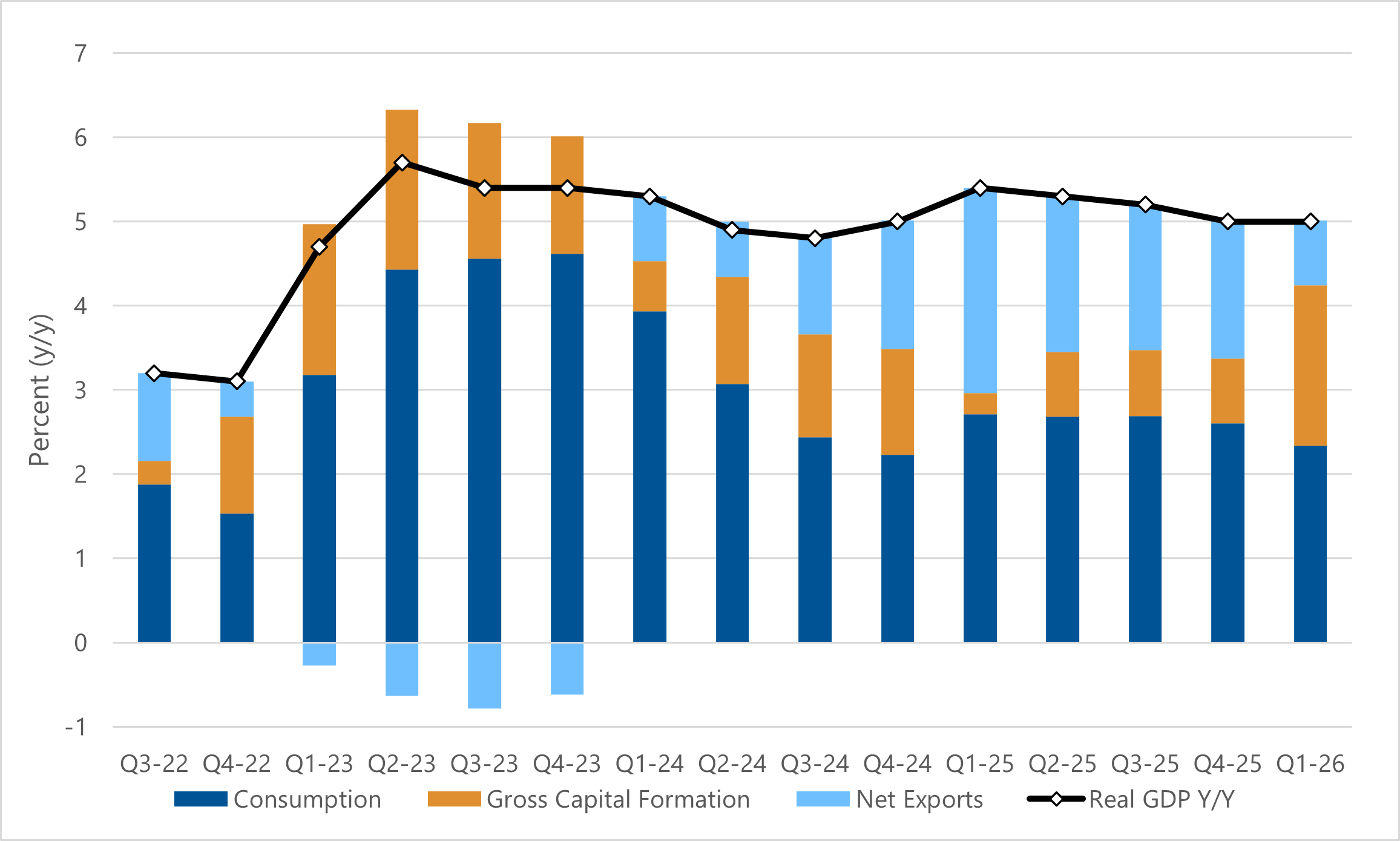
According to official figures, China registered 5.0 percent growth in Q1 2026. Closer examination reveals still-weak consumption, inconsistent data reporting methodology, and headwinds from inflationary pressure brought on by the war in Iran.
- Weak consumption: China has repeatedly pledged to rebalance its economy toward consumer spending but has not followed through. Retail sales growth bottomed out in December 2025 (0.9 percent year-on-year), then rose slightly to 2.8 percent in early 2026 before slowing again in March to 1.7 percent.[1] A 9.1 percent drop in auto sales for Q1 dragged down retail spending for the quarter.[2] In an effort to stabilize prices, Beijing had subsidized trade-ins of cheaper models in favor of higher-end models.[3] Beijing’s “anti-involution” action led to an excess supply of lower-priced cars, fueling exports—China’s passenger car exports rose 60.6 percent year-on-year in Q1.[4]
- Inconsistent data: Higher-than-expected topline growth owes in part to downward revision of 2025 numbers.[5] The National Bureau of Statistics (NBS) also reported a bounceback in fixed asset investment (FAI), an indicator closely watched by markets as a driver of demand for commodities. FAI dropped 3.8 percent last year but jumped 1.7 percent in Q1 2026.[6] The infrastructure portion of FAI grew 8.9 percent year-on-year during Q1 2026 after declining 2.2 percent in all of 2025.[7] The sharp increase was driven partly by NBS adding power investment into the figure, which had previously been tracked separately by the National Energy Administration.[8]
- Inflation: China’s consumer and producer inflation both rose in March—1.0 and 0.5 percent, respectively—driven by higher fuel costs.[9] As Trivium China analysts note, inflation from an external shock, rather than an organic rise in consumer confidence, puts China’s economy in a precarious position: it is harder for producers to pass price increases onto consumers without reducing demand, further compressing already razor-thin margins.[10]
Figure 1: Contributions to GDP Y/Y Growth (Quarterly, Not Seasonally Adjusted, YTD), Q3 2022–Q1 2026
China Shock 2.0 Deepens; Voracious Appetite for Advanced Semiconductors Helps Reduce Trade Surplus
Developing markets saw the brunt of a 14 percent surge in China Shock 2.0 as China’s market distortions continue to cause an export deluge to global markets. Meanwhile, China’s demand for high-end semiconductor imports surged on the back of rising AI investment.
- China’s export surge continued in Q1 2026, with double-digit growth in exports to developing markets and a shift in export composition to higher-value goods.[11] China’s exports in the first quarter of 2026 grew 14 percent year-on-year to $977.6 billion, according to China’s General Administration of Customs.[12] China’s Q1 exports to countries in Southeast Asia and Africa grew 20 percent and 32 percent, respectively; the EU also recorded a 21 percent increase as Chinese exports rebounded from slower growth following EU tariffs on Chinese electric vehicles (EVs) in 2024.[13] Conversely, exports to the United States fell 16 percent.[14]
Figure 2: China’s Trade Surplus in March 2026 Reaches Four-Year Low, March 2020–March 2026
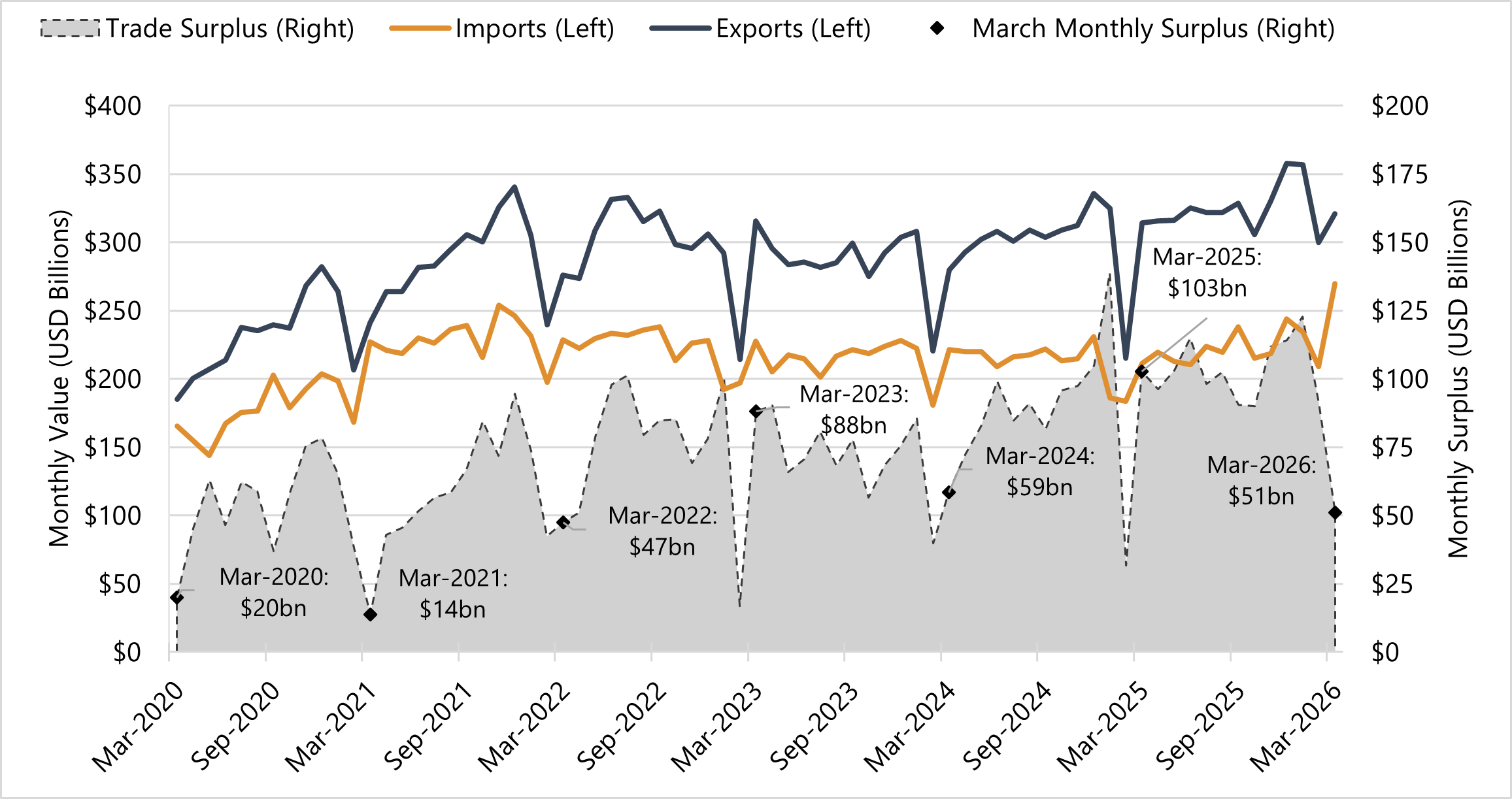
- Even with the continuing export surge, China’s trade surplus actually declined due in part to a record $135 billion in semiconductor imports in the last quarter as demand for AI compute in China has skyrocketed.[15] These numbers highlight China’s continued reliance on foreign-made advanced chips.
- More broadly, China saw a 27 percent increase in the value of imported electronics and high-technology products during Q1.[16] Rising fuel costs in March have had less impact on China’s trade balance so far, as crude oil imports were down 2.8 percent by volume and natural gas 10.7 percent compared to March 2025.[17]
- Export growth was driven by strong performance in China’s higher-value-added exports such as EVs and lithium batteries. [18] But exports of low-value-added goods like footwear and garments fell as input costs increased.[19] Analysts expect China’s exports of new energy goods to gain if the conflict in Iran drags on and hastens the energy transition in countries with high oil-import dependencies.[20] At the same time, export growth potential could diminish in the short run as emerging economies—China’s fastest-growing customers—experience increasing inflationary pressures caused by the increase in oil prices.[21]
- Taken together, higher input prices and a weakening prognosis for emerging markets growth paints a difficult picture for China. In the near term, China is relatively insulated from energy shocks due to high EV adoption, substantial oil reserves, and heavy coal use. However, China’s exporters have increasingly limited room to stay competitive by lowering their prices as margins are squeezed.[22] Industrial value added in March grew just 0.3 percent on a month-to-month basis.[23] The deceleration in growth from January and February suggests pressure on profit margins and that weak demand may be weighing on output since the start of the conflict.[24]
China’s Aggressive Naval Activities Seek to Intimidate U.S. Allies
The People’s Liberation Army (PLA) framed its operations as a response to the most expansive U.S.-Philippine-led Balikatan exercises to date.
- The PLA Eastern Theater Command sent a task group through two sensitive Japanese waterways April 19–22 after a Japanese destroyer transited the Taiwan Strait on April 17 to join Balikatan—marking the first time Japan has participated in the exercise in a combat role.[25] The PLA’s unusual routes passed by two Japanese islands hosting military garrisons and appeared intended to intimidate Tokyo.[26]
- On April 24, the PLA Southern Theater Command (STC) announced the deployment of a task group to conduct live-fire drills in the waters east of the Philippines’ Luzon Island and used language indicating the operations were a response to Balikatan.[27] Satellite imagery and regional reporting confirmed the deployment of at least 14 ships, including the Liaoning aircraft carrier and a submarine. The live-fire drills featured YJ-20 hypersonic anti-ship missiles, which China unveiled at a military parade in 2025.[28]On April 30, the STC conducted naval and air patrols around Scarborough Shoal and released a video of a fighter pilot locking on to what appears to be a Philippine patrol aircraft.[29]
- These events likely signal Beijing’s increasing willingness to use a show of force to respond to U.S.-allied security cooperation activities.
China Intensifying Sovereignty Claims Over Indian State of Arunachal Pradesh
Beijing refers to Arunachal Pradesh as “South Tibet” and considers it a “core interest”—placing it in the same category as Taiwan.
- On April 10, 2026, China’s Ministry of Civil Affairs published a list of locations in Arunachal Pradesh that it had renamed with Mandarin titles.[30] India’s Ministry of External Affairs immediately condemned the political maneuver, which is the latest Chinese attempt to undermine India’s sovereignty over the border state.[31]
- Arunachal Pradesh has long been considered a target for future PLA military operations, with China expanding dual-use facilities near the border, including an airbase 70 miles from the Tibetan Buddhist monastery in Tawang.[32] Beijing is resettling Chinese citizens along the border in hundreds of villages, creating “permanent surveillance nodes and barracks” for acclimatized Chinese soldiers.[33] China also recently detained an Indian citizen from Arunachal Pradesh in a Chinese airport, calling her passport invalid and arguing that she was Chinese.[34]
- These developments are heightening fears in India that a future confrontation over Tawang could be more severe than the December 2022 clash between Chinese and Indian soldiers.[35] In the Commission’s Hearing on India, China, and the Balance of Power in the Indo-Pacific, witness Sameer Lalwani warned that a military clash, even if it started small, might afford China the pretext to wrest control of Tawang and larger parts of Arunachal Pradesh from India.[36]
China Creates New Tools for Technology Competition and Supply Chain Leverage
China is taking steps to strengthen its economic and national security toolkit. The State Council recently issued two new regulations targeted at industrial supply chain security and countering its interpretation of “exterritorial jurisdiction” by foreign states.
- On April 7, the State Council issued the Regulations on Industrial and Supply Chain Security (Decree No. 834), expanding the PRC government’s authority to investigate and impose countermeasures on foreign companies deemed to be harming China’s supply chain security.[37] Articles 13 and 15 introduce new restrictions on entities conducting supply chain-related investigations within China, potentially targeting due diligence firms alongside companies looking to de-risk from China.[38] Previous frameworks were triggered by compliance with foreign legislative action rather than commercial behavior.[39] As is often the case for China’s national security-related laws, enforcement authorities have immense discretion to determine what constitutes a violation, creating further risk for foreign firms operating in China.[40]
- Additionally, on April 13, the State Council released the Regulations on Countering Foreign Improper Extraterritorial Jurisdiction (Decree No. 835), which give China authority to exercise extraterritorial jurisdiction over acts with an “appropriate connection” to China to safeguard national security.[41] The regulations introduce new mechanisms, such as the “Malicious Entity List,” designed to target individuals and companies that comply with U.S. and allied sanctions.[42] They also contain what legal experts refer to as “piercing rules” that can be used to threaten parent companies and affiliated entities based on the actions of a subsidiary or affiliate, even if the activity occurs outside of China.[43] These measures are intended to deter compliance with U.S. sanctions and export controls.
- Beijing likely views both decrees as important new economic statecraft tools for U.S.-China technology and supply chain competition. In an April 20, 2026, People’s Daily article, National Development and Reform Commission (NDRC) Chairman Zheng Shanjie called for strengthening China’s economic security toolkit and emphasized countermeasures against sanctions and “long-arm jurisdiction,” reinforcing the policy direction behind the new regulations.[44]
- USCC’s 2025 Supply Chain Leverage chapter previously analyzed Xi Jinping’s push to advance “rule by law” mechanisms to formalize and expand China’s economic coercion toolkit.[45] Amid a U.S.-China trade truce and an upcoming leadership summit, the regulations may signal Beijing’s intent to blunt U.S. tools and increase Chinese leverage over U.S. firms in future disputes.
China Flexes Its Muscles to Keep AI Innovations at Home: Tries to Block Meta’s Acquisition of Manus
China’s NDRC blocked Meta’s acquisition of Manus, an AI agent startup with Chinese roots. This represents the first time the NDRC publicly used its foreign investment review to block investment in China’s AI sector.
- On April 27, the Office of the Security Review Working Mechanism for Foreign Investment, under the NDRC, blocked Meta’s $2 billion acquisition of Manus and ordered both parties to cancel the transaction.[46] Since the investigation began in January 2026, as the Commission noted in the February China Bulletin, Beijing has barred Manus’s CEO Xiao Hong—who was appointed vice president of Meta following the acquisition—from leaving China.[47]
- The NDRC bases its authority on the 2020 Measures for the Security Review of Foreign Investment, treating Manus's relocation to Singapore—including the transfer of its core team, research and development (R&D) capabilities, training data, and intellectual property—as a national security concern designed to circumvent Chinese oversight and attract U.S. investment. [48]This marks the first time Beijing has issued a public decision to block foreign investment in China’s AI sector, emphasizing how it views AI as a critical technology with national security risks.[49]
- While Beijing may have some leverage to enforce the decision, the extent to which it can fully unwind the deal remains uncertain. Despite its platforms being blocked in China, Meta’s Chinese advertising business generated $18 billion in 2024.[50] If Meta does not comply, the NDRC could impose penalties and even criminal charges.[51] Enforcement would require Meta to terminate the transaction agreement; relinquish all de facto control of Manus; ensure Meta receives the full $2 billion refund; and destroy all acquired data, technology, and documentation.[52] Meta has already integrated Manus into some of its tools, making the disentanglement process complex, costly, and time-consuming.[53] Beijing raised concerns over the transfer of technology and knowhow, but the unwinding may also create a subtler impact for Meta. During the integration period, Manus’s core team may have absorbed valuable technical knowledge from Meta, making the transfer of knowhow potentially a two-way street.
More broadly, Beijing is sending signals to China’s homegrown AI companies that they cannot sever ties with China to receive U.S. (if not all foreign) investment without government intervention.[54] Chinese AI firms have looked to U.S. investors to fund their capital-intensive operations, as domestic private-sector (i.e., non-state-backed) investment was stagnant in 2025, a sharp contrast to the massive surge in AI private investment in the United States last year.[55] Manus is not the first to follow this playbook: other firms with Chinese roots, including Tabcut and Wiz.ai (both relocated to Singapore) and HeyGen (moved to Los Angeles), pursued similar strategies.[56] Beijing recently ordered MiroMind not to relocate and issued similar warnings to AI labs Moonshot and Stepfun as they explore initial public offering options.[57]
This issue of the China Bulletin was prepared by Graham Ayres, Benton Gordon, Ngor Luong, Zoe Merewether, Eric Omorogieva, Matthew Sperzel, and Lyndi Tsering. You may reach us at contact@uscc.gov.
Disclaimer: This bulletin is the product of research performed by professional staff of the U.S.-China Economic and Security Review Commission (USCC) and was prepared to support the ongoing research and deliberations of the Commission. Posting of this bulletin to the Commission’s website is intended to promote greater awareness and understanding of developing issues for congressional staff and the public in support of the Commission’s efforts to “monitor, investigate, and report” on U.S.-China economic relations and their implications for U.S. national security, as mandated by Public Law 106-398 (as subsequently modified in law, see uscc.gov/charter). The public release of this document does not imply an endorsement by the Commission, any individual Commissioner, or the Commission’s other professional staff, of the views or considerations raised in this staff-prepared bulletin.
Endnotes
[1] China’s National Bureau of Statistics, Total Retail Sales of Consumer Goods from January to March 2026, April 17, 2026. https://web.archive.org/web/20260420195608/https://www.stats.gov.cn/english/PressRelease/202604/t20260417_1963351.html.
[2] China’s National Bureau of Statistics, Total Retail Sales of Consumer Goods from January to March 2026, April 17, 2026. https://web.archive.org/web/20260420195608/https://www.stats.gov.cn/english/PressRelease/202604/t20260417_1963351.html.
[3] Claire Yuan, Danny Huang, and Stephen Chan, “Industry Credit Outlook: Auto Brief: China Subsidy Extension Unlikely to Stop 2026 Sales Drop,” S&P Global, January 7, 2026. https://www.spglobal.com/ratings/en/regulatory/article/industry-credit-outlook-auto-brief-china-subsidy-extension-unlikely-to-stop-2026-sales-drop-s101664458.
[4] China’s General Administration of Customs, via Haver Analytics; “China's Auto Inventory Alert Index in March 2026 Edges Up Both YoY, MoM,” Gasgoo, March 31, 2026. https://autonews.gasgoo.com/articles/news/chinas-auto-inventory-alert-index-in-march-2026-edges-up-both-yoy-mom-2038921154499100672; Chan Ho-Him, “China’s Auto Sales Sink in February as Phase Out of Subsidies for Trade-Ins Hits Demand,” Associated Press, March 11, 2026. https://apnews.com/article/china-autos-evs-tarifffs-fcb551ab7875dd37470b49c986122ef0.
[5] Keith Bradsher, “China’s G.D.P. Stronger than Expected, Led by Infrastructure Spending,” New York Times, April 15, 2026. https://www.nytimes.com/2026/04/15/business/china-economy-growth.html; China’s National Bureau of Statistics, Preliminary Accounting Results of GDP for the Fourth Quarter and Full Year of 2025, January 21, 2026. https://web.archive.org/web/20260430203350/https://www.stats.gov.cn/english/PressRelease/202601/t20260121_1962363.html.
[6] China’s National Bureau of Statistics, National Economy Got Off to a Good Start in the First Quarter, April 16, 2026. https://web.archive.org/web/20260430203024/https://www.stats.gov.cn/english/PressRelease/202604/t20260416_1963326.html.
[7] China’s National Bureau of Statistics, via Haver Analytics; Allen Feng, “Apples to Oranges in Infrastructure Investment Data,” Rhodium Group, April 20, 2026.
[8] Allen Feng, “Apples to Oranges in Infrastructure Investment Data,” Rhodium Group, April 20, 2026.
[9] China’s National Bureau of Statistics, via Haver Analytics.
[10] Joe Peissel, “The Wrong Kind of Inflation: How the Iran War Ended China’s Deflation Cycle,” Trivium China, April 14, 2026. https://triviumchina.com/research/the-wrong-kind-of-inflation-how-the-iran-war-ended-chinas-deflation-cycle/.
[11] “Why China’s Exports Will Keep On Rising,” Economist, April 21, 2026. https://www.economist.com/china/2026/04/21/why-chinas-exports-will-keep-on-rising.
[12]China’s General Administration of Customs, via Haver Analytics.
[13]China’s General Administration of Customs, via Haver Analytics; Lisa O’Carroll, “EU Faces ‘China Shock’ as EV Imports Drive Beijing’s Record Surplus with Bloc,” Guardian, April 27, 2026. https://www.theguardian.com/world/2026/apr/27/eu-faces-china-shock-as-ev-imports-drive-beijings-record-surplus-with-bloc.
[14]China’s General Administration of Customs, via Haver Analytics.
[15] “Economists Rethink Chinese Forecasts as AI Fires Up Import Surge,” Bloomberg, April 27, 2026. https://www.bloomberg.com/news/articles/2026-04-26/economists-rethink-chinese-forecasts-as-ai-fires-up-import-surge; Eduardo Baptista, “AI Boom Accelerates China’s Chip Industry Growth as Demand Strains Supply Chain,” Reuters, March 25, 2026. https://www.reuters.com/business/autos-transportation/ai-boom-accelerates-chinas-chip-industry-growth-demand-strains-supply-chain-2026-03-25/; China’s General Administration of Customs, via Haver Analytics.
[16]China’s General Administration of Customs, via Haver Analytics.
[17] Sam Li and Lewis Jackson, “China's March Crude Oil Imports Unscathed by Iran War, Gas Imports Hit a Multi-Year Low,” Reuters, May 1, 2025. https://www.reuters.com/business/energy/chinas-march-crude-oil-imports-unscathed-by-iran-war-gas-imports-hit-multi-year-2026-04-14/.
[18] “Macro Wrap | China’s Q1 GDP Data: The Cracks Are Deepening,” Trivium China, April 17, 2026; China’s General Administration of Customs, “总值创同期新高 进出口均呈两位数增长 从首季数据看中国外贸‘进阶路’” [Total Trade Value Reaches Record High with Both Imports and Exports Showing Double-Digit Growth. First-Quarter Data Shows Chinese Trade “Leveling Up”], April 16, 2026. http://www.customs.gov.cn/customs/2026-04/16/article_2026041610093191862.html; Keith Bradsher, “China’s G.D.P. Stronger than Expected, Led by Infrastructure Spending,” New York Times, April 15, 2026. https://www.nytimes.com/2026/04/15/business/china-economy-growth.html.
[19] “Macro Wrap | China’s Q1 GDP Data: The Cracks Are Deepening,” Trivium China, April 17, 2026; Keith Bradsher, “China’s G.D.P. Stronger than Expected, Led by Infrastructure Spending,” New York Times, April 15, 2026. https://www.nytimes.com/2026/04/15/business/china-economy-growth.html.
[20] Savannah Billman, “How China’s EV Companies Are Winning the War,” Wire China, April 19, 2026. https://www.thewirechina.com/2026/04/19/how-chinas-ev-companies-are-winning-the-war/; David Hart, “With Hormuz Closed, China Is Wiring the Globe’s Clean Energy Future,” Council on Foreign Relations, April 16, 2026. https://www.cfr.org/articles/with-hormuz-closed-china-is-wiring-the-globes-clean-energy-future.
[21]William Sandlund, Ramsay Hodgson, and George Steer, “Will the Iran War Amplify the ‘Second China Shock’?” Financial Times, May 3, 2026. https://www.ft.com/content/3acc349c-437b-4b09-8008-e6eb04052612; Rodrigo Campos, “IMF Says Middle East War to Deepen Economic Divide in Latin America, Caribbean,” Reuters, April 17, 2026. https://www.reuters.com/world/americas/imf-says-middle-east-war-deepen-economic-divide-latin-america-caribbean-2026-04-17/; Gabriele Steinhauser and Chelsey Dulaney, “Oil Crisis Hitting Asia Foreshadows Tough Times for Europe,” Wall Street Journal, April 5, 2026. https://www.wsj.com/finance/commodities-futures/oil-crisis-asia-europe-africa-iran-war-ea883ba2; Sui-Lee Wee et al., “Reeling from the Iran War’s Oil Shock and ‘Running Out of Ideas,’” New York Times, March 20, 2026. https://www.nytimes.com/2026/03/20/world/asia/iran-war-oil-thailand-vietnam-philippines.html.
[22] “China Emerges from Oil Shock with Industry Profits Masking Split,” Bloomberg, April 27, 2026. https://www.bloomberg.com/news/articles/2026-04-27/china-s-industrial-profits-surge-as-reflation-offsets-cost-shock.
[23]China’s National Bureau of Statistics, via Haver Analytics.
[24]China’s National Bureau of Statistics, via Haver Analytics; “Macro Wrap | China’s Q1 GDP Data: The Cracks Are Deepening,” Trivium China, April 17, 2026.
[25] “Japanese Ground Troops Join Rapidly Growing Balikatan Exercise in Philippines,” Indo-Pacific Defense Forum, April 19, 2026, https://ipdefenseforum.com/2026/04/japanese-ground-troops-join-rapidly-growing-balikatan-exercise-in-philippines/; “海上自衛隊の艦船、10か月ぶり台湾海峡通過…中国の「世論戦」に利用されぬよう慎重に時期検討,” [Japan Maritime Self-Defense Force Ships to Pass Through the Taiwan Strait for the First Time in 10 Months... The Timing Was Carefully Considered to Avoid Being Used in China’s "Public Opinion Warfare"], Yomiuri Shimbun, April 17, 2026. https://www.yomiuri.co.jp/politics/20260417-GYT1T00280/.
[26] Japan Joint Staff, Regarding the Movements of Chinese Naval Vessels [中国海軍艦艇の動向について], April 22, 2026. https://www.mod.go.jp/js/pdf/2026/p20260422_03.pdf; China’s Ministry of National Defense, 东部战区组织133号舰艇编队过航横当水道,赴西太平洋海域开展演训活动 [The Eastern Theater Command Organized the No. 133 Naval Flotilla to Transit the Hengdang Channel and Conduct Training Exercises in the Western Pacific Ocean], April 19, 2026. https://web.archive.org/web/20260422151220/http://www.mod.gov.cn/gfbw/qwfb/16455991.html; Yumiko Urasaki, “Japan’s Closest Garrison to Taiwan Takes Bigger Role 10 Years On,” Nikkei Asia, March 26, 2026. https://asia.nikkei.com/politics/defense/japan-s-closest-garrison-to-taiwan-takes-bigger-role-10-years-on; “本土と沖縄を結ぶ重要地点・奄美大島で任務に励む自衛隊員たち,” [Self-Defense Forces Personnel Diligently Carrying Out Their Duties on Amami Oshima, a Crucial Point Connecting Mainland Japan and Okinawa], Mamor, February 14, 2024. https://mamor-web.jp/_ct/17659086.
[27] China’s Ministry of National Defense, 107编队位菲律宾吕宋岛以东海域开展演训活动 [PLA Southern Theater Command Naval Task Group 107 Conducts Military Exercises in Waters East of the Philippine Luzon Island], April 24, 2026. https://web.archive.org/web/20260428125831/http://www.mod.gov.cn/gfbw/qwfb/16457105.html.
[28] “How Powerful Is the Chinese Carrier Strike Group Staging a Show of Force near the Philippines?” Military Watch, April 27, 2026. https://militarywatchmagazine.com/article/how-powerful-chinese-carrier-group-philippines; Alcott Wei, “PLA Showcases YJ-20 Hypersonic Missiles as Balikatan Drills Heat Up South China Sea,” South China Morning Post, April 27, 2026. https://www.scmp.com/news/china/military/article/3351593/pla-showcases-yj-20-hypersonic-missiles-balikatan-drills-heat-south-china-sea; Amber Wang, “China Stages Navy Drill as US and Philippines Embark on Balikatan 2026,” South China Morning Post, April 24, 2026. https://www.scmp.com/news/china/military/article/3351353/china-stages-navy-drill-us-and-philippines-embark-balikatan-2026.
[29]China’s Ministry of National Defense, 中国人民解放军南部战区位中国黄岩岛领海领空及周边区域组织战备警巡 [The Southern Theater Command of the Chinese People's Liberation Army Organized Combat Readiness Patrols in the Territorial Waters and Airspace Surrounding Huangyan Island], April 30, 2026. https://web.archive.org/web/20260501165033/https://www.xinhuanet.com/20260430/fab2c77e170f463dacdb2423757b068d/c.html; Fan Fan, Tang Ya, and Zhang Yuying, “PLA Repels Philippine Aircraft’s Illegal Intrusion over China’s Huangyan Dao: Source,” Global Times, March 18, 2026. https://web.archive.org/save/https://www.globaltimes.cn/page/202603/1357156.shtml.
[30] “Zangnan Is China’s Territory and China Has Never Recognized So-Called ‘Arunachal Pradesh’ Illegally Set Up by India, Says FM on India Rejecting China’s Naming of Places in Zangnan,” Global Times, April 14, 2026. https://archive.ph/OvveM; China’s Ministry of Foreign Affairs, 2026年4月14日外交部发言人郭嘉昆主持例行记者会 [On April 14, 2026, Foreign Ministry Spokesperson Guo Jiakun Presided over a Regular Press Conference], April 14, 2026. https://web.archive.org/web/20260420162630/https://www.mfa.gov.cn/web/wjdt_674879/fyrbt_674889/202604/t20260414_11891610.shtml.
[31] “India Rejects China Renaming Places in Arunachal, Flags Impact on Ties,” India Today, April 13, 2026. https://www.indiatoday.in/india/story/india-rejects-china-renaming-places-in-arunachal-flags-impact-on-ties-2895216-2026-04-13.
[32] Sameer Lalwani, written testimony before the U.S.-China Economic and Security Review Commission, Hearing on India, China, and the Balance of Power in the Indo-Pacific, February 17, 2026, 5; China’s China-Tibet News Network, 西藏自治区国民经济和社会发展第十五个五年规划纲要 [The Outline of the 15th Five-Year Plan for National Economic and Social Development of Tibet Autonomous Region], official press release, February 14, 2026. https://web.archive.org/web/20260416180048/https://www.xzxw.com/zw/qwfb/2026-02/14/content_6762610.html.
[33] Sameer Lalwani, written testimony before the U.S.-China Economic and Security Review Commission, Hearing on India, China, and the Balance of Power in the Indo-Pacific, February 17, 2026, 7; Thomas Hader et al., “China’s Gray-Zone Infrastructure Strategy on the Tibetan Plateau: Roads, Dams, and Digital Domination,” Center for Strategic and International Studies, June 4, 2025, 8.
[34] Michael Kugelman and Srujan Palkar, “Dispatch from New Delhi: Another India-China Flare-Up Is Coming,” Atlantic Council, December 10, 2025. https://www.atlanticcouncil.org/dispatches/dispatch-from-new-delhi-another-india-china-flare-up-is-coming/.
[35] Sameer Lalwani, written testimony before the U.S.-China Economic and Security Review Commission, Hearing on India, China, and the Balance of Power in the Indo-Pacific, February 17, 2026, 5; Michael Kugelman and Srujan Palkar, “Dispatch from New Delhi: Another India-China Flare-Up Is Coming,” Atlantic Council, December 10, 2025. https://www.atlanticcouncil.org/dispatches/dispatch-from-new-delhi-another-india-china-flare-up-is-coming/; India and China Troops Clash on Arunachal Pradesh Mountain Border,” BBC, December 13, 2022. https://www.bbc.com/news/world-asia-63953400.
[36] Sameer Lalwani, written testimony before the U.S.-China Economic and Security Review Commission, Hearing on India, China, and the Balance of Power in the Indo-Pacific, February 17, 2026, 12.
[37] China’s State Council, China Issues Regulations on Industrial and Supply Chain Security, April 7, 2026. https://web.archive.org/web/20260407144314/https://english.www.gov.cn/policies/latestreleases/202604/07/content_WS69d5038cc6d00ca5f9a0a460.html.
[38] China’s State Council, “产业链供应链安全管理条例” [Regulations on Industrial and Supply Chain Security], April 7, 2026. https://web.archive.org/web/20260426155237/https://www.gov.cn/zhengce/content/202604/content_7064837.htm.
[39] China’s Ministry of Commerce, MOFCOM Order No. 1 of 2021 on Rules on Counteracting Unjustified Extra-Territorial Application of Foreign Legislation and Other Measures, January 8, 2021. https://english.mofcom.gov.cn/Policies/GeneralPolicies/art/2021/art_98677d0ed28b41b9adeff27b00c9d001.html#:~:text=The%20rules'%20purpose%20is%20to:%20*%20Counteract,application%20of%20foreign%20legislation%20and%20other%20measures.
[40] Wester van Gaal, “EU Businesses Warn China’s New Supply Chain Law Puts Firms on Collision Course with Bloc’s Rules,” Eu Observer, April 13, 2026. https://euobserver.com/210991.
[41] China’s State Council, “中华人民共和国反外国不当域外管辖条例” [PRC Regulations on Countering Improper Extraterritorial Jurisdiction by Foreign States], April 13, 2026. https://www.gov.cn/zhengce/content/202604/content_7065398.htm.
[42] Todd Liao et al., “China Issues New Regulations on Countering Foreign Extraterritorial Jurisdiction: What Multinational Companies Need to Know,” Morgan, Lewis & Bockius LLP, April 16, 2026. https://www.morganlewis.com/pubs/2026/04/china-issues-new-regulations-on-countering-foreign-extraterritorial-jurisdiction-what-mncs-need-to-know.
[43] Todd Liao et al., “China Issues New Regulations on Countering Foreign Extraterritorial Jurisdiction: What Multinational Companies Need to Know,” Morgan, Lewis & Bockius LLP, April 16, 2026. https://www.morganlewis.com/pubs/2026/04/china-issues-new-regulations-on-countering-foreign-extraterritorial-jurisdiction-what-mncs-need-to-know.
[44] Zheng Shanjie, “持续提升国家经济安全保障能力以新安全格局保障新发展格局” [China Ups Legal Tools to Counter Foreign Long-Arm Jurisdiction], Xinhua, April 20, 2026. https://www.news.cn/politics/20260420/239a6cae48394dd48030981be7b60772/c.html; “China Is Securitizing Its Economy,” Merics, April 23, 2026. https://merics.org/en/merics-briefs/china-securitizing-its-economy.
[45] U.S.-China Economic and Security Review Commission, 2025 Annual Report to Congress, November 2025, 476.
[46] China’s National Development and Reform Commission, “外商投资安全审查工作机制办公室(国家发展改革委)
对外资收购Manus项目作出安全审查决定” [Office of the Working Mechanism for the Security Review of Foreign Investment (National Development and Reform Commission) Made a Security Review Decision on the Foreign Acquisition of the Manus Project], April 27, 2026. https://zfxxgk.ndrc.gov.cn/web/iteminfo.jsp?id=20623.
[47] Cissy Zhou and Yifan Yu, “China’s Block of Meta-Manus Deal Spooks Entrepreneurs and Investors,” Nikkei, April 28, 2026. https://asia.nikkei.com/business/technology/artificial-intelligence/china-s-block-of-meta-manus-deal-spooks-entrepreneurs-and-investors; Cate Cadell and Nitasha Tiku, “China Bars Executives at Meta-Owned AI Company from Leaving Country,” Washington Post, March 25, 2026. https://www.washingtonpost.com/national-security/2026/03/25/meta-manus-china-executives-banned/.
[48] Peng Jun et al., “从中国外商投资安全审查视角看Meta-Manus交易的合规性” [The Compliance of the Meta-Manus Transaction from the Perspective of China’s Foreign Investment Security Review], Lexology, April 27, 2026. https://www.lexology.com/library/detail.aspx?g=0ad887a9-0603-40b1-aeec-caccf32b2158; China’s National Development and Reform Commission, “外商投资安全审查办法” [Measures for the Security Review of Foreign Investment], December 19, 2020. https://www.ndrc.gov.cn/xxgk/zcfb/fzggwl/202012/P020201219582032130362.pdf.
[49] Zhao Yunfan, “National Development and Reform Commission: Foreign Acquisition of Manus Project Prohibited” [国家发展改革委:禁止外资收购Manus项目], 21st Century Business Herald, April 4, 2026. https://finance.eastmoney.com/a/202604273720867683.html.
[50] Meghan Bobrowsky, “Meta’s Ad Business Relies a Lot on China. Tariffs Could Hurt It, Warns Analyst,” Wall Street Journal, April 3, 2025. https://www.wsj.com/livecoverage/trump-tariffs-trade-war-stock-market-04-03-2025/card/meta-s-ad-business-relies-a-lot-on-china-tariffs-could-hurt-it-warns-analyst--YJmuFIn3dL5a9yVBEoVa.
[51] Arjun Neil Alim et al., “China Blocks Meta’s $2bn Purchase of AI Group Manus,” Financial Times, April 27, 2026. https://www.ft.com/content/1e4c269a-5258-406c-a308-e55c3d5d640f?syn-25a6b1a6=1.
[52] Peng Jun et al., “从中国外商投资安全审查视角看Meta-Manus交易的合规性” [The Compliance of the Meta-Manus Transaction from the Perspective of China’s Foreign Investment Security Review], Lexology, April 27, 2026. https://www.lexology.com/library/detail.aspx?g=0ad887a9-0603-40b1-aeec-caccf32b2158.
[53] Coco Feng et al., “With Meta-Manus AI Deal ‘Difficult’ to Undo, How Will Beijing Exert Its Authority?” South China Morning Post, April 28, 2026. https://www.scmp.com/tech/article/3351718/meta-manus-ai-deal-difficult-undo-how-will-beijing-exert-its-authority.
[54] “China to Curb US Investment in Tech Companies After Meta Deal,” Bloomberg, April 24, 2026. https://www.bloomberg.com/news/articles/2026-04-24/china-to-curb-us-investment-in-tech-companies-after-meta-deal.
[55] “Artificial Intelligence Index Report,” Stanford Human-Centered Artificial Intelligence, 2026, 183. https://hai.stanford.edu/assets/files/ai_index_report_2026.pdf.
[56] Caroline Crosdale, “Meta’s Recent Acquisition Worries Chinese Regulators,” GFMAG, February 17, 2026. https://gfmag.com/capital-raising-corporate-finance/metas-recent-acquisition-worries-chinese-regulators/.
[57] “China to Curb US Investment in Tech Companies After Meta Deal,” Bloomberg, April 24, 2026. https://www.bloomberg.com/news/articles/2026-04-24/china-to-curb-us-investment-in-tech-companies-after-meta-deal; Rebecca Tan and Lyric Li, “Beijing Tightens Its Grip on AI Firms That Try to Shed Their Chinese Ties,” Washington Post, April 21, 2026. https://washingtonpost.com/world/2026/04/21/china-ai-competition-manus-meta.