×
Filter Results
Filter Results
Research Proposals
The Commission invites submission of proposals to provide concise unclassified reports in emerging technology, economics and trade, China’s activities in India and Latin America, or other novel ideas.
Research Proposals
The Commission invites submission of proposals to support the Commission’s research on the national security implications of the bilateral trade and economic relationship between the United States and the PRC.

Staff Paper
China is undermining tools of economic statecraft by facilitating sanctions and export control evasion on behalf of Russia, Iran, and North Korea. These autocratic countries increasingly are coordinating efforts to circumvent sanctions and export controls and transact outside of the dollar-based financial system.
Research Proposals
The Commission invites submission of proposals to provide concise unclassified reports in emerging technology, supply chain vulnerability, China’s gray zone activities, and other novel ideas.
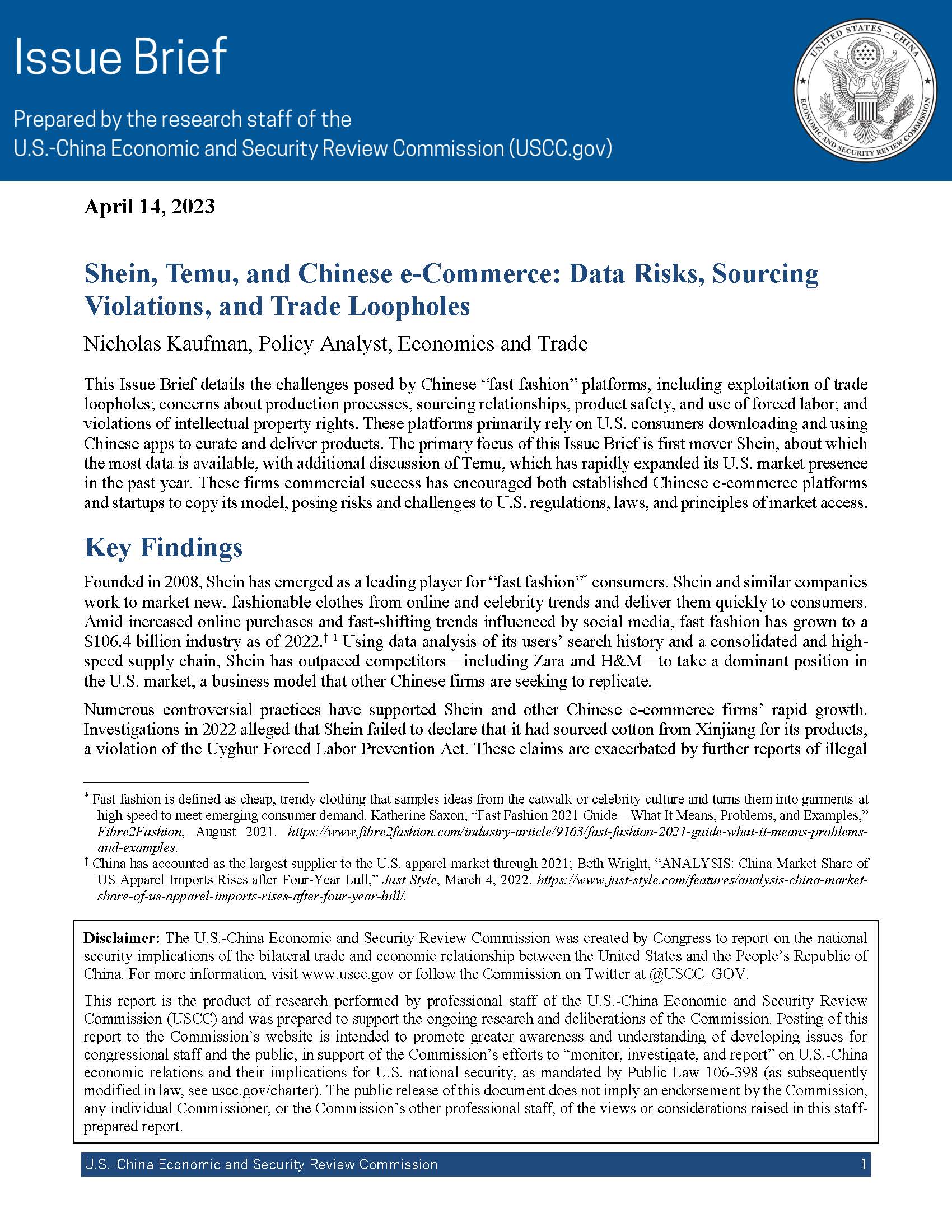
Issue Brief
This Issue Brief details the challenges posed by Chinese “fast fashion” platforms, including exploitation of trade loopholes; concerns about production processes, sourcing relationships, product safety, and use of forced labor; and violations of intellectual property rights. These platforms primarily rely on U.S. consumers downloading and using Chinese apps to curate and deliver products.
The primary focus of this Issue Brief is first mover Shein, about which the most data is available, with additional discussion of Temu, which has rapidly expanded its U.S. market presence in the past year. These firms commercial success has encouraged both established Chinese e-commerce platforms and startups to copy its model, posing risks and challenges to U.S. regulations, laws, and principles of market access.
Staff Paper
The report reviews China’s food security challenges and how these vulnerabilities drive interests in U.S.-China agricultural relations.

Issue Brief
On January 15, 2020, President Donald Trump and China’s Vice Premier Liu He signed a “Phase One” trade agreement. It forms part of an effort to resolve trade tensions that have been ongoing since March 2018, when the Office of the U.S.
Issue Brief
In 2018, China reported several cases of African swine fever, or ASF, a highly contagious disease that is deadly to pigs. The disease has now spread throughout China, where it has already reduced the country’s hog population by more than 50 million, and throughout other countries in Asia. This report provides an overview of the ASF outbreak in China, the implications for U.S. exports of pork and animal feed products, and the risks posed to U.S. food safety and food security.
Issue Brief
This issue brief provides an update to the Commission's February 2017 report on fentanyl flows from China, examining the progress of negotiations between U.S. and Chinese law enforcement authorities. Although the Chinese government has taken steps to reduce the manufacture and export of fentanyl-like substances, China remains the largest source of illicit fentanyl and fentanyl-like substances in the United States. To combat these flows, U.S. authorities have begun taking legal actions against known Chinese drug traffickers, including announcing the first ever indictments and sanctions against Chinese fentanyl traffickers.
Staff Paper
Since joining the World Trade Organization in 2001, China has leveraged relatively cheap labor, large economies of scale, industrial policies, and the manufacturing capabilities of neighboring countries to become an export powerhouse in an increasing range of industries, while often limiting market access for foreign products. China’s scale as a trading power coupled with its protectionist policies have contributed to rising tensions in bilateral trade relations. This report describes and analyzes patterns in the U.S.-China trade relationship in 2012–2017 and is an update to a staff research report published by the Commission in November 2012 which covered trends in trade in 2000–2011.